The following is an extract from my novel “Captain Cobbler” which is due to be published later this year (target date – October 1st 2013)… Nicholas Melton, my namesake, became Captain Cobbler in 1536, but this extract isa glimpse into his life at age 16…
The stories about Saint John the Evangelist and the punishment are both true… and since it is 500 years since Henry Vlll personally went to war with France, it seems an opportune time to share these tales more widely…enjoy!
Falling from Grace: Understanding truth
Remembering…a Hostelry in Newark, April 1516
“….and it were so wet and muddy that big St. John the Evangelist slipped and slithered in t’ mud, overbalanced completely and ended up, face down in t’ ditch, in two foot of water. We pushed and pulled for nigh on a quarter of an hour, but we couldn’t move him an inch.”
Young Nicholas – soon to be turning 16 years old – was just coming into the colourful tavern in the south-west corner of Newark Market place, from the pelting rain outside and was both unnerved and puzzled by this overheard tale. He quickly cast his mind back over the Biblical learning he had imbibed as a child but could find no recollection of such a story about the extraordinary demise of one of the Apostles, for surely he must have drowned, face-down, in that depth of water?
Nor could he readily grasp why the teller of this tale, a rough-hewn and stocky man, stubbly of countenance and with but three fingers to his right hand, was telling it as if it happened only the day before. Clearly, it must have happened a millennium and a half ago – if, of course, it had happened at all! Very strange!
Despite a great and sudden urge to deny the truth of such an outrageous story, as any hot-blooded, well-schooled youth of fifteen would naturally be tempted to do, he was minded to keep his counsel. Indeed, he was kept quiet, not least, by the efforts he and his companion needed to expend to get comfortable and dry in the crowded hostelry, for it was truly foul weather outside that day.
Firstly, they had to divest themselves of their sodden hats and riding capes without incurring the wrath of the other occupants of the room, most of whom had been indoors long enough to be thoroughly dried out from the persistent downpour. Then, they had to find space to be seated – a task made so much easier by Nicholas’ robust, not to say rumbustious, and well-acquainted fellow traveller, William Cole. Cole was not of Newark Town itself, but he was well known there, not least in ye Olde White Hart Inn, in the southern-most corner of Newark market-place, where they now found themselves.
“Move along that bench now, Jake Hoskyns, otherwise you’ll be joining yon fine pig on the spit, agen the fire!”
“I’m warm enough now, thank’ee, Bill“, Jake said, laughing, but moving nonetheless.
“As for you, young David” – here, Bill Cole was addressing a skinny youth of about Nicholas’ age – “you’re taking up far more than your fair share of room in that big chair. Landlord! Bring us a stool from the kitchen!”
The stool appeared, David moved (with much better grace than Nicholas thought he might have managed in similar circumstances) and William eased himself into a well-warmed, substantial oaken chair by the blazing log fire, opposite the three fingered yarn-spinner. Nicholas perched himself, damply, on the end of the bench trying hard not to disturb the current occupants of the bench who were already dry and warm.
By the time everyone had settled down again, and a copious platter of well-roasted pork and steaming pease pudding, fresh baked bread and a large mug of ale had appeared in front of the new arrivals, it had become clear to young Nicholas that ‘..big St John the Evangelist..’ was no-one of human form.
In fact, it was a large brass siege cannon, lost in a ditch no more than a few miles out of the English stronghold of Calais. And that the time of the tale was less than three years earlier, during the summer of 1513, at the start of King Henry’s French campaign.
Nicholas flushed up to the hairline at the potential for embarrassment if he’d have spoken up scornfully when they first entered the room, as he might so easily have done. Fortunately no-one noticed his discomfort, or, if they did, merely put it down to the heat of the fire bringing rosiness to his cheeks.
Gradually, the warmth and good food brought him greater physical comfort as he recovered from the long day’s ride he’d had through the surging spring storm.
His spirits, too, were lifted by the convivial company in the busy Inn. Bill Cole had thought to send word ahead to the innkeeper early that week, so that they were assured of a room and a bed for the night, despite the lateness of the hour and the impending market on the morrow.
Indeed, notwithstanding the heavy rain, the cobbled town square had still been bustling with men struggling with the elements to put up the stalls for the morning trade. Men cursing the rain, cursing the blustering wind which kept whipping awnings from their slippery-fingered grip and cursing each other for fools and knaves when shouted instructions were misunderstood, or misheard, in the howling weather.
As Nicholas now learned, it was the state of the weather which had brought on the recollection of big St John’s fall from grace, from the old soldier seated near the fire grate. Although he answered to the epithet “Three-fingered Jack”, his given name was John Fuller and he spoke with the friendly intonation of a Yorkshire accent.
“I ‘ad a full ’and of fingers at the time”, he was saying, “..’appen I’ll tell you ‘ow I lost ‘un before the evening’s out though, if the ale keeps a’coming in!”
He smiled, disarmingly.
He’d obviously been through the saga before and now had it down to a fine art, knowing just how many jugs of ale and platters of victuals his stories were worth, given a ready audience and a warm fire.
“I’ll tell you straight“, he went on, leaning forward confidentially, “the weather were as bad as today, if not worse. ‘Twas about three years since, …1513 as I recall. In fact, when we set off from Calais three days before, it were so bad that we got nobbut three miles down the road an’ we ‘ad to pack in fer the day. Most of the fancy tents for the noble lords was nigh on impossible to put up. Those we got up, mostly didn’t stay up and I hazard that not a soul got a wink of sleep that night, not even young King Henry hisself.”
“Fine figure of a man he is, too, six foot four they say, and sturdy as an Oak. The King rode all round that night and, near as I can tell, spoke to everyone in sight. ‘Well comrades‘ he sez to us, ‘now that we have suffered in the beginning, fortune promises us better things, God willing.’ An’ we all believed him, a’ course, – he looked you straight in the eye and meant it true, as sure as I sit here with you this e’en.”
There was something about John Fuller at that point, with his voice quiet and his sense of complete conviction, that when he stopped speaking there was a hush of affirmation over the room; with just the crackle of the log fire, and the occasional spit of fat from the nearly eaten porker, to disturb the silence.
Fuller sat back, took a long pull from his jug of ale, expelled an equally long breath and spoke again in normal tones but with a touch of irony in his voice.
” ‘course, like a’most everything else I knows of, it got worse afore it got better. Aye, and for some,” he added with faded sadness, “it ne’er did get any better.”
“We didn’t move the next day, being Sunday, but on the Monday we marched another five or six miles to a town called Ardres, which were in enemy territory. The townsfolk had promised to provide us wi’ vittals as long as we let ’em alone.”
“Well! No-one had thought to tell this to the Germans, – or, if they did, they only told ’em in English! So these Almain mercenaries, together wi’ a few of our lads went on the rampage, looking for loot. They was told to quit in the hour and no messin’. But they didn’t take a deal of notice of that message either and, in the end, our King Henry went in hisself, with some of ‘is own guards, an’ sorted ’em out.”
“They say he strung at least three Almains up in the town square by the neck to set the matter to rights.”
“Whether the looting upset the Frenchies I can’t rightly say; or mebbe they thought to test our nerve; but some of their light cavalry kept having at us from behind. Then, them of ours as were at the front, decided to get a bit of a move on,” …he spoke confidentially, directly to Nicholas, or so it seemed, “…shoulder to shoulder they was at this stage, for protection like, wi’ weapons drawn.”
“We was trying to keep up at the back … and that were when big St John went to baptise hisself.”
“As I said afore, we pulled an’ pushed, pushed an’ pulled and got oursens nowhere, e’en wi’ a full team of Flanders mares. Then t’ ’igh and mighty Master Carpenter from Calais, mester George Buckemer, came farting around and took it upon hisself to get Saint John high and dry wi’ a ‘…carefully crafted block and tackle..‘ or so he said, all ‘oity toity, like.”
“None o’ the officers or Nobles liked ‘im too well, so they left ‘im to get on wi’it. Aye, and us, too. I’d say there were nigh on a ‘undred of us to ‘elp lift and ‘ammer and pull an’ all.”
There was another pause for a theatrically timed gulp of ale by the narrator, who then leaned forward and dropped his voice, taking the whole room into his confidence again.
“We was at this game for just over an hour when the bad fish I’d eaten the night before got t’ better of me an’ I ‘ad to dive away into the bushes as quick as you like.”
He leaned back again in his chair and shook his head slowly from side to side, as if not even believing, himself, what he was now about to say.
“Masters, one and all,” he paused, looking round at the attentive throng, ‘…that bad fish surely saved my life.”
“There I were, groaning my innards out, behind a large laurel bush, when the whole French army descended from t’ nearby hills and laid into ‘igh an’ mighty mester Buckemer and my comrades, wi’out mercy. Only about ten of our lot was fightin’ men, the rest just workmen, joiners, blacksmiths – like me – carters, an’ coopers and the like.”
“Well – they did t’ best they could. But it were a bloodbath, and over in nobbut a few minutes. Them as weren’t killed…Aye, an’ that were precious few…. was trussed up an’ carted off, goodness knows where. I ‘aven’t seen ’em since, anyroad.”
“And there were nowt I could do. I were ‘elpless behind a shrub wi’ my leggin’s round my ankles, daring not even to breathe, let alone groan anymore.”
“I got the most terrible cramps in my legs, but I nivver moved a muscle ’til ‘alf an hour after the last Frenchman ‘ad left. By the time I’d got meself moving again and caught up wi’ the rest of the lads who had left us to it earlier, it were just about dark. The truth ‘ad somehow got back to camp afore I did and everyone were talking about it. One of our little four man scouting groups on ‘orseback ‘ad been sent to find out what t’delay were all about – but they must’ve taken a different road from me, ‘cos I saw nowt of ’em, goin’ or comin’.”
John Fuller lapsed into silence at this point and if, afterwards, you’d asked any man then present in the room, he would have said there was a ‘..tear in the eye of Three-fingered Jack..’ as he leaned his head back on the old oak settle.
Someone called for more ale all round and, by turns, the noise level in the bar rose to a convivial hubbub once more.
Nicholas, who had listened to the tale as avidly as the next man, was now ready for his bed, if the truth were told. He had, after all, been up since four o’clock that morning and the food, drink and warm fire were all conspiring to close his eyes, but his companion, big Bill Cole, with a strange edge to his voice, had just asked John Fuller what happened next. Nicholas decided it would be unseemly to leave before the tale was finished.
“What ‘appened next, you say sir?”
“Aye, sir, I do.”
“Well, sir, for several days, nowt much at all. We all waited round, dryin’ out in t’ summer sun, repairing tents and the like. We was just past the town of Tournehem, on the river Hem, ‘…wherein lay as fair a castle as you might wish to see…‘ as I heared one o’ our fine lords say to another, ‘…set, exquisite, in rolling wooded countryside…’ Fine words or not, it were a pretty sight, I’ll grant.”
“Young King Henry were in a right fine temper about losing one of ‘is twelve Apostles. We all heard ‘im a’shoutin’ at my good Lord Essex, for such a carry on – specially when ‘e found out that the Frenchies ‘ad walked away with one of our bombards, we called the ‘Red Gun’.”
One of the younger voices in the room piped up to ask “Why was that, sir?”
“Why – because of the colour it were painted, sir!”
The possibility of such an obvious answer had eluded the young man and the assembled throng guffawed in kindly mocking of his innocence. He wisely played no further part in the conversation.
Three fingered Jack took up again with his tale.
“To cut the long of it short, sirs, my lord Essex and Sir Rees ap Thomas was sent back wi’ my lord Berners, the ‘Mester of Ordnance’ and ‘is pioneers and a great troop of archers and swordsmen to see if they could recover Saint John. ‘e were still in t’ ditch, yer see!”
“An’ it were dry now, so the job were a lot easier. It were a great blessin’, too, that I’d ‘aten no bad fish the night before, much to the benefit of big St John and meself – for it weren’t needed to save my life this day, ‘cos we wasn’t attacked again, until we’d got the Evangelist out of the river.”
“The Frenchies tried a skirmish or two, but me an’ my comrades got the better of them this time an’ soon sent ’em packing.”
“Aye, an’ no doubt you played a hero’s role this time“, Bill Cole’s voice boomed into the temporary quiet.
Nicholas was startled into wakefulness by the ferocity of his friend’s jibe. Puzzled by the animosity of the tone, as was everyone in the room, Nicholas waited to hear more.
The tendons in Bill Cole’s neck stood out with apoplectic fury and his eyes bulged. Everyone had been so intent on Fuller’s story that Cole’s deepening anger had gone unnoticed.
“The tale you tell is accurate in every detail except one, my friend.”
No-one in the room could have heard so much venom crammed into the word ‘friend’ as they heard just then.
“The minor detail you have wrong is that you weren’t even there.”
“I know, because I was! Oh, – I have no doubt you were in France. And I have a good idea how you lost your finger, too, which I shall relate in a moment, – but you were certainly not with big St John the Evangelist that day!”
Fuller now began to look very uncomfortable, his eyes darting round looking for a quick way out of the crowded room.
There wasn’t one! In becoming the centre of attention for his story telling, he had also become totally encircled by his audience. The focus was now on William Cole, his deep anger seeming more under control as he spoke again.
This time he addressed his remarks to the room at large, taking over the role of story teller.
“We did lose big St John in a ditch and those of us as were left with George Buckemer to pull the Evangelist out were attacked with little mercy by the French army. I got a broken rib and a six inch scar on my back to prove it. There were sixteen of us alive after the attack but my young brother Jeb and a goodly number of my friends lost their lives, hacked to death in the space of but a few minutes. We had no chance. Totally surrounded and outnumbered.
“I was bundled into a cart with three other men who couldn’t walk and we were taken back to the coast at Boulogne, where we were held until after King Henry’s army returned to England. We were treated civilly enough and once my rib had mended we were free to wander round the town during the day, for the gates were well guarded and we couldn’t get to the boats.”
Bill Cole now even smiled a little at a prompted recollection.
“I managed to learn some of the French tongue from a pretty serving wench in one of Boulogne’s taverns. At least enough to ask for wine, butter and eggs.”
“And where the nearest bed was!” Jake Hoskyns added to much laughter all round.
“How did this’un lose his finger, then, Bill?” another voice asked from the crowd.
“I don’t know for sure“, said Bill with great honesty, “but before we set out from Calais I heard tell of a man who was caught asleep on guard duty three times in one night by the watch sergeant.”
“The punishment for this crime is special to Calais, although I do hear tell they do something similar in Berwick, up North, for dozy watchmen who drink too much for their own good – Aye, and for all they’re watching over too!”
“If someone on watch is caught asleep twice, and the sergeant of the watch finds him asleep again and is able to twist his nose for him, without him waking up first, then he’ll be put under lock and key until morning, when the whole town will be called out to watch him pay the penalty.”
All the time he was relating this tale, Bill Cole was watching John Fuller as close as could be. Fuller, meanwhile, kept his eyes glued to the ground.
“They have a special large basket, hanging out from the town wall over the sea. It’s a bit like a crab catching basket, but big enough to hold a man. In the basket he goes and in with him goes a loaf of bread and a bottle of wine and a knife.”
“The bread is to stop him starving, the wine to give him Dutch courage to face the long drop and the knife to cut the rope that holds the basket to the wall. The art is to get the timing right.”
“They say that time and tide wait for no man!”
“If the tide is out, the drop to the rocks is enough to break a few bones at the very least if it doesn’t break your skull open! But, of course, if the tide is right in and the basket doesn’t break open straight away, then you’ll probably drown instead!”
“If you time it right though, – so that the water is deep enough to break your fall, but shallow enough to let your basket break on the rocks without drowning you in the process, – you have a chance of staying alive!”
“I wasn’t in Calais at the time – I arrived a week after it had happened – but I heard tell of a man being caught asleep three times in one night. He apparently survived.”
Bill Cole paused dramatically.
“But he did lose one of the fingers from his right hand when he bounced on the rocks!”
At this point, Three-fingered Jack looked up from the floor and he had about him the haughty yet frightened look of a stag at bay. His breathing was fast and shallow, his cheeks flushed, his eyes darting about searching for a desperate route for escape.
There was nowhere to go!
He took a deep breath and spoke in a defiant tone.
“So, what if it were me? So…what…?” His voice cracked, and the tears that formed in his eyes were real this time. Tears of self-pity. It was the first time he had been found out in nearly two years of story-telling.
Into the silence that followed big William Cole spoke briefly once more.
“In Calais they call this punishment the ‘Fall from Grace’.”

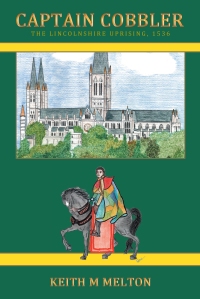


 Captain Cobbler 1536